Why Most Casino Pages Fail (And What Separates the Ones That Don't)
Almost every casino brand page starts the same way. A logo, a launch post, a welcome bonus, a couple of game screenshots. Six weeks later the posting slows down. Three months later the page is still there, technically alive, quietly ignored — and nobody on the team can say exactly when it stopped mattering.
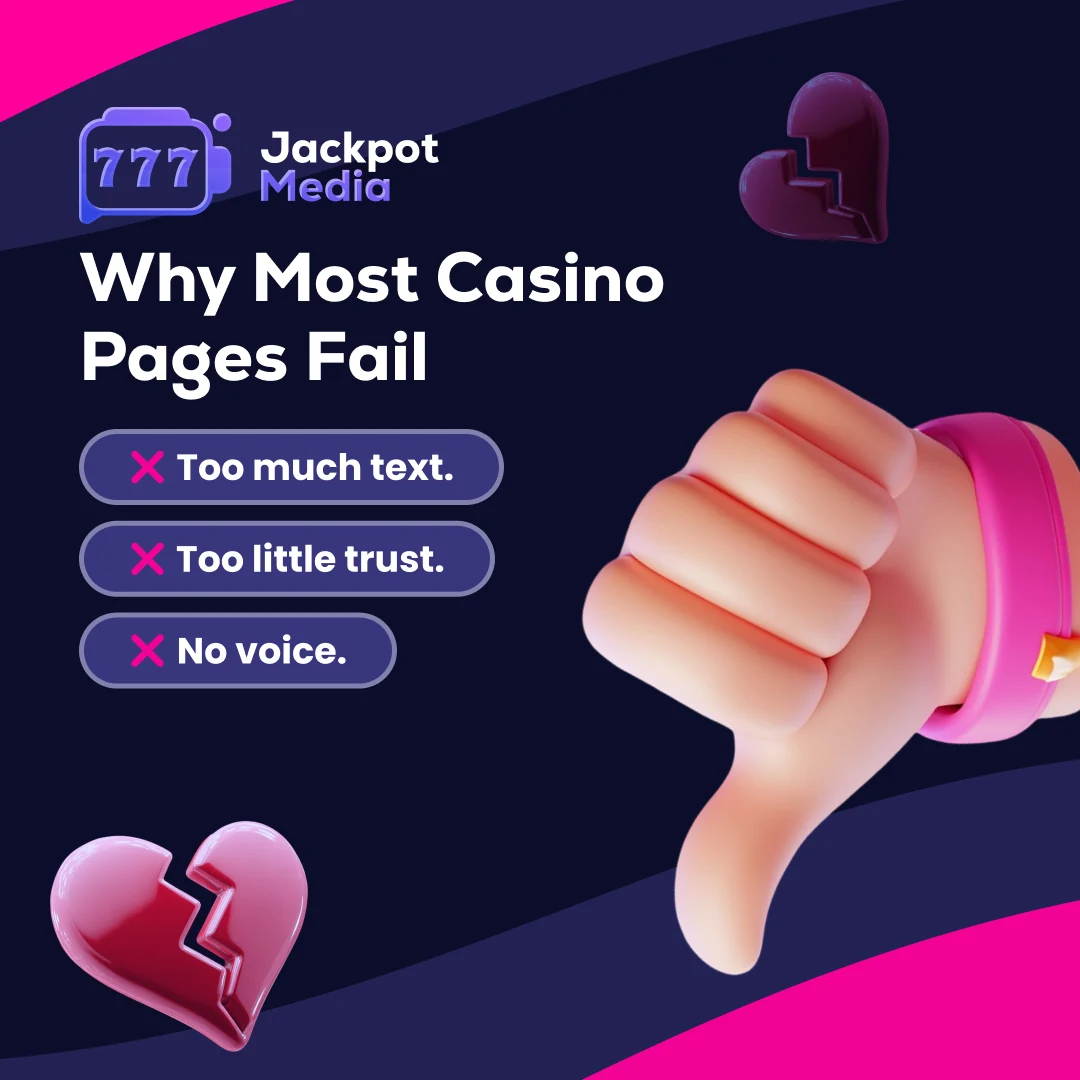
This is not a design problem, and it is rarely a budget problem. The same three failures show up again and again, across markets and across brands. They are easy to describe and uncomfortable to fix, because fixing them means admitting the page was built for the operator rather than for the player.
Failure one: too much text
The instinct is understandable. There is a lot to explain — the bonus structure, the wagering requirement, the game selection, the payment methods, the licence. So it all goes on the page, in the caption, in the image itself.
The result is a post that nobody finishes. A player scrolling on a phone gives a piece of content somewhere between one and three seconds to earn the next three. A dense block of terms and conditions does not earn anything. Worse, it signals effort in the wrong direction: the brand is working hard to be thorough rather than working hard to be understood.
The correction is not "write less". It is to decide what a single piece of content is for. One idea per post. The bonus terms belong on the bonus page, where a player who already wants the bonus will read them carefully. The post only needs to make that player exist.
Failure two: too little trust
Gambling content operates under a permanent handicap: the audience assumes it is being sold to, and assumes the seller has an edge. That assumption is not unfair. It is the correct default for the category.
Most pages respond to this by making bigger promises — larger bonus numbers, more exclamation marks, more urgency. This has the opposite effect of the one intended. The louder the claim, the more it confirms the suspicion.
Trust in this category is built with specifics, not volume. A payout screenshot with a visible timestamp does more than a headline about fast withdrawals. A named payment method that the local audience actually uses does more than the phrase "instant deposits". A clear answer to "what happens if I lose access to my account" does more than another promotion.
None of this is expensive. It is simply less exciting to produce than another bonus announcement, which is why it usually loses the argument internally.
Failure three: no voice
Open ten casino brand pages in a given market and cover the logos. In most cases nothing distinguishes them. The same stock visuals, the same superlatives, the same three exclamation marks, the same generic call to action.
A page without a recognisable voice cannot be remembered, and anything that cannot be remembered has to be paid for every single time it appears. This is the hidden cost of interchangeability: it converts a brand asset into a permanent media expense.
Voice does not mean humour or personality for its own sake. It means a consistent point of view that a regular reader could recognise with the logo removed — a specific tone, a specific set of subjects, a specific way of handling wins and losses. It is the difference between a page a player follows and a page a player tolerates.
Why follower counts hide all three
These failures survive because the most visible metric does not detect them. Followers can be bought, borrowed from a giveaway, or accumulated from an audience with no intention of ever depositing. A page can grow steadily while every underlying problem gets worse.
The honest questions are narrower and less flattering:
- How many registrations came from this channel, not how many clicks
- How many of those registrations reached a first deposit
- How many first depositors came back for a second one
- What a player from this channel is worth compared with a player from paid media
An operator who can answer those four questions can afford to ignore follower counts entirely. An operator who cannot is measuring the wrong thing, and a page can fail for a full quarter before the numbers admit it.
What the pages that work do differently
They are not more creative. They are more decided.
They know which single audience they are talking to, and they lose the rest on purpose. They publish fewer things and finish them properly. They show evidence instead of claiming outcomes. They keep a consistent voice long enough for it to become recognisable, which takes longer than most content plans allow for. And they measure the part of the funnel that involves money, not the part that involves applause.
None of that requires a larger budget. It requires deciding what the page is for before deciding what to post on it — which is the step most brands skip, because it is the only one that cannot be outsourced.
Key takeaways
- Dense, exhaustive content fails because it asks for attention before earning it — one idea per piece, with the details where an interested player will look for them.
- In gambling the audience defaults to distrust, so louder promises deepen the problem; specifics and verifiable evidence are the only reliable correction.
- A page with no recognisable voice must be paid for on every impression, because nothing about it is remembered between appearances.
- Follower growth can continue while all three failures get worse, which is why registrations, first deposits, redeposits and player value are the only useful measures.
Building the funnel behind the content
Content problems and platform problems are usually mistaken for each other. A page can be doing its job while registrations stall at the deposit step, and no amount of creative work will fix that. If you want to see where players actually drop out between the first click and the second deposit, talk to our team →
Disclosure: This blog may include references to services we offer. Our team develops Professional iGaming Platforms, and provides consulting for gaming operators on analytics, compliance, and platform setup.
Author: Alex S
Growth Department at Jackpot Media. iGaming content and traffic.